

Does Acetone Kill Nail Fungus?
- Published by: Payam Sarraf
- on
- | Updated on March 16, 2026
You found a yellow, thick, or crumbly toenail and grabbed the nail polish remover sitting on your shelf. It makes sense since acetone is strong, it smells like it could kill anything, and it’s right there. But does acetone kill nail fungus? The short answer is no. And using it the wrong way can actually make things worse.
Let’s break down why acetone does not work as a nail fungus treatment, how it can be used safely as a prep step, and what actually gets rid of toenail fungus (onychomycosis) for good.
If you are dealing with a stubborn fungal nail infection in Phoenix or anywhere in the Valley, our podiatrists at Foot + Ankle Specialty Centers are here to help.
Table of Contents
ToggleCan Acetone Kill Nail Fungus?
No. Acetone does not kill nail fungus. Acetone is the main ingredient in most nail polish removers. It can dissolve the top layer of a thickened or discolored nail, and it cleans the surface, but it has no antifungal properties at all. It cannot kill the fungal cells that are causing the infection.
Here is the problem. Nail fungus, also called onychomycosis, does not just sit on top of the nail. It lives deep inside the nail plate and sometimes in the nail bed underneath. Acetone evaporates in seconds. Even if it had antifungal properties, it does not stay on the nail long enough to penetrate where the infection actually lives.
People reach for acetone because it is cheap, easy to find, and already in the house. That is completely understandable. But acetone is not built to fight fungal infections. It is a solvent, not an antifungal.
And if you use it too much or too often, it can actually make your nail situation worse. Regular acetone use can:
- Dry out and weaken the nail plate
- Irritate and crack the skin around the nail
- Make nails more brittle and easier to break
- Strip natural oils from the skin, creating small openings for more infection
So will acetone kill nail fungus? No. You need professional nail fungus infection treatment in Phoenix.
Why is Acetone Ineffective for Nail Fungus?
There are clear reasons why acetone does not work against nail fungus. Here they are, simply put:
- Acetone has zero antifungal properties, so it cannot kill fungal cells at any depth.
- It evaporates within seconds of contact, giving it no time to work even on the surface.
- Nail fungus lives deep inside the nail plate and nail bed, far beyond where acetone can reach
- Acetone only dissolves surface material and does not penetrate the layers where the infection is rooted.
- It disrupts the skin barrier around the nail, which can actually invite more fungal growth.
- Using it repeatedly dries and weakens the nail, making it harder for real treatments to work.
- It has no residual effect, meaning once it dries, it stops doing anything at all.
- Studies on antifungal treatments do not include acetone because it has never shown clinical effectiveness against onychomycosis.
How to Use Acetone for Nail Fungus?
Once again, acetone does not kill nail fungus. Its only role is to help prepare the nail so that the real treatment can work better. What acetone can help with:
- Removing nail polish or gel that blocks medication
- Slightly softening thick nails before filing
- Cleaning the nail surface before applying antifungal treatment
That’s it. It can be a prep step. Here’s how to use it properly:
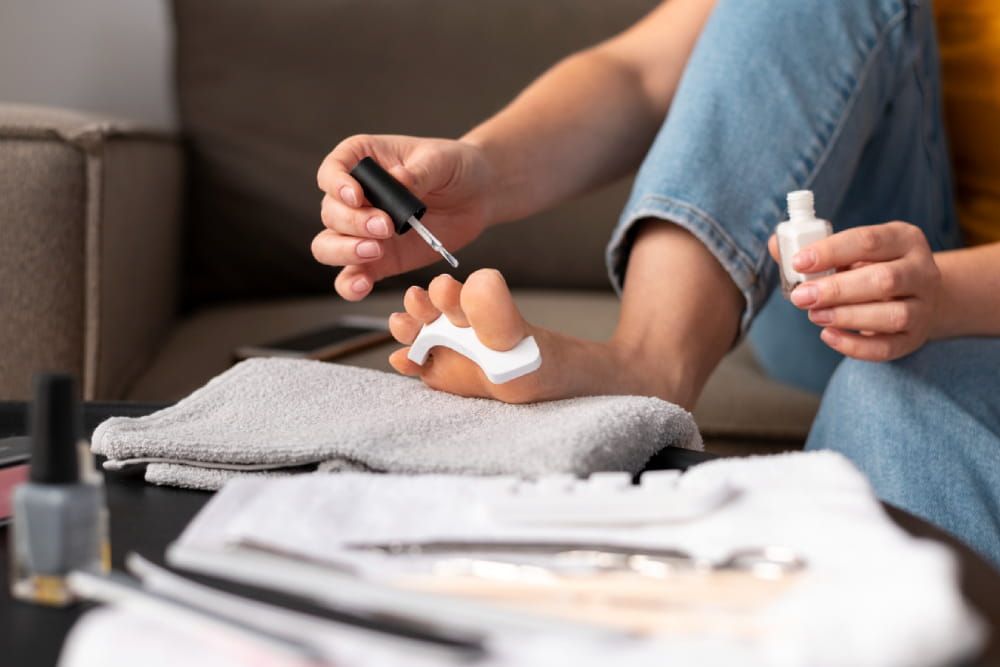
- Soak a cotton ball with acetone, press it on the nail for 30–60 seconds, and wipe clean because polish blocks medication.
- Gently thin the top of the nail with a disposable file so the medication can penetrate better, and discard the file after each use.
- Allow the nail and surrounding skin to dry completely, since fungus thrives in moisture.
- Apply an over-the-counter antifungal or a prescription such as ciclopirox or efinaconazole as directed by your podiatrist.
- Apply the treatment daily and stay consistent, because toenails grow slowly and clearing the infection can take several months.
Important Cautions
- Do not soak your entire foot in acetone. It dries and cracks the skin.
- Use acetone only on the nail.
- If you have diabetes, poor circulation, or nerve problems, do not try home treatment without seeing a podiatrist. Small cracks in the skin can become serious infections.
Better Treatment Options
If acetone does not kill nail fungus, what does? Here are the treatments that actually work:
| Treatment | How It Works | Best For |
| Oral antifungals (terbinafine, itraconazole) | Kill fungus through the bloodstream | Moderate to severe infections |
| Prescription topical lacquers (ciclopirox, efinaconazole) | Applied daily to the nail | Mild to moderate infections |
| Over-the-counter antifungals (clotrimazole, tolnaftate) | Treat fungus on the nail surface | Very early or mild cases |
| Laser treatment | Uses light energy to target fungus under the nail | Drug-free treatment option |
| Nail debridement (podiatrist) | Thins thick nails to improve treatment results | Thick or advanced infections |
| Prescription nail solutions | Applied like polish for daily antifungal contact | Mild cases or combination therapy |
Quick Take-Aways:
- Oral antifungals are generally most effective for moderate to severe infections.
- Topical lacquers help in milder cases, especially with good adherence.
- Laser and professional nail care are valuable additions, especially when pills aren’t an option or the infection is stubborn.
The right option depends on how severe your infection is, how many nails are affected, and your overall health. At Foot + Ankle Specialty Centers, our Phoenix podiatrists can tell you exactly which treatment, or combination of treatments, gives you the fastest and safest path to clear nails.
Effective Nail Fungus Treatment in Phoenix
Acetone does not kill nail fungus, and it does not go away on its own. The longer it sits, the deeper it grows, the harder it is to treat, and the more likely it spreads to other nails. If acetone has not helped, and it won’t, it is time to see a specialist.
At Foot + Ankle Specialty Centers, Dr. Payam Sarraf, DPM, and our team of board-certified podiatrists diagnose nail fungus accurately and build a treatment plan that is right for your specific case. We do not guess. We use the right tools, the right treatments, and the right follow-up to get you clear nails as fast as possible.
We have five Valley locations ready to see you in Phoenix, Scottsdale, Chandler, Mesa, and Gilbert. We offer same-day and next-day appointments.
Do not wait for the infection to spread. Call us today at 480-812-3668. The sooner you treat it, the easier it goes away.
FAQs
Will acetone kill nail fungus?
No. Acetone has no antifungal properties and evaporates too quickly to affect the fungus, which lives deep inside the nail plate.
What will actually kill nail fungus?
Prescription oral antifungals like terbinafine are the most effective treatment. Prescription topical lacquers, laser therapy, and consistent over-the-counter antifungals can also work depending on the severity of the infection.
How long does it take to get rid of nail fungus?
Even with the right treatment, it typically takes three to six months for a toenail to fully clear because nails grow slowly.
Can nail fungus spread to other nails?
Yes. Nail fungus is contagious and can spread from one nail to another, and also to the skin. Treating it early and keeping your feet clean and dry is the best way to stop it from spreading.
- 1

Payam Sarraf
Payam Sarraf, DPM, is a podiatry specialist and surgeon at Foot + Ankle Specialty Centers, with offices in Gilbert, Scottsdale, Chandler, and Phoenix, Arizona. Dr. Sarraf’s areas of expertise include ankle trauma, Achilles tendon ruptures, podopediatrics, ankle arthroscopy and reconstruction and biomechanics.
Related posts
- Payam Sarraf
- September 3, 2026
- No Comments
Toe curling happens when your toes bend downward and inward toward the bottom of your foot. Common causes include muscle spasms, nerve problems, dystonia, toe deformities, […]
- Payam Sarraf
- August 29, 2026
- No Comments
Cracked heels develop when dry, thick skin splits under pressure from standing or walking. To help them heal, soak your feet, exfoliate the dry skin, moisturize […]

- Payam Sarraf
- August 29, 2026
- No Comments
High heels can cause a forward weight shift, which puts extra pressure on your toes and the front of your feet. A narrow toe box may […]