

Are Plantar Warts on Feet Contagious?
- Published by: Payam Sarraf
- on
- | Updated on October 1, 2026
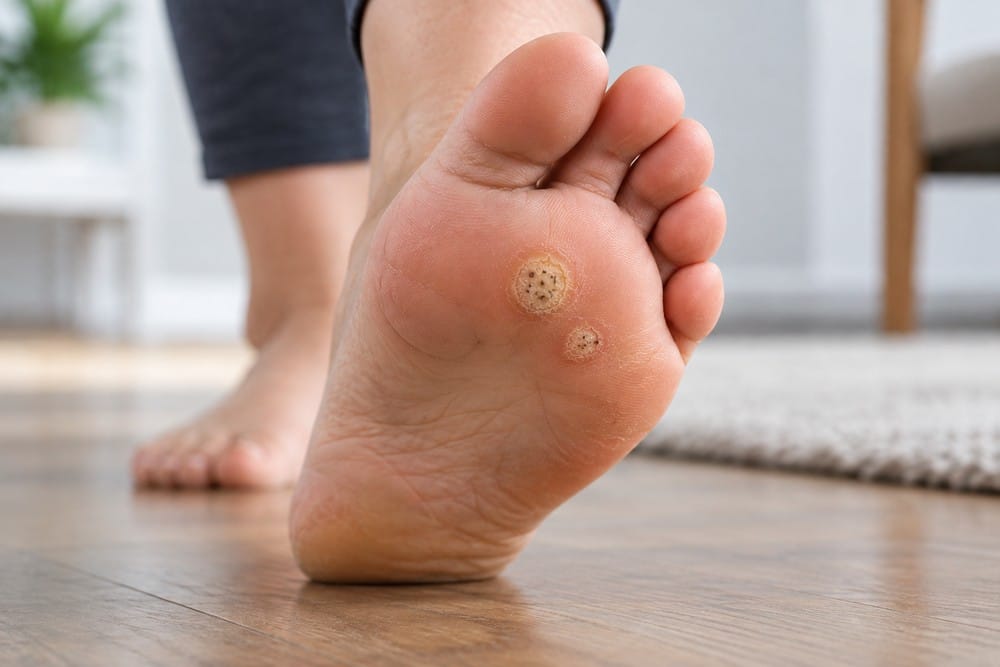
Plantar warts are contagious skin infections caused by HPV (human papillomavirus). The virus can spread through direct contact or contaminated surfaces, such as shared showers, locker room floors, and pool areas. It enters the skin and causes a wart to develop on the bottom of the foot.
If you want to learn more about “Are Plantar Warts Contagious?”, this guide is for you. In this guide, Foot + Ankle Specialty Centers explains how plantar warts spread, what causes them, how to treat them, and how to prevent them.
Table of Contents
ToggleAre Plantar Warts Contagious?
Yes, plantar warts are contagious because they are caused by HPV (human papillomavirus). According to the Mayo Clinic, plantar warts can spread through contact with the virus on your skin or on shared surfaces, such as locker room floors, showers, and pool areas. You can also spread the virus from one area of your foot to another by touching or scratching the wart.
How Do Plantar Warts Spread?
Plantar warts spread when the HPV virus enters the skin through tiny breaks, cuts, or weak areas on the bottom of the foot. The virus may stay in the skin and slowly cause a wart to develop. People who have sweaty feet, damaged skin, or spend time in warm, damp places may have a higher chance of getting plantar warts.
The virus does not spread through casual contact alone. It usually needs a way to enter the skin before an infection can happen.
How Long Are Plantar Warts Contagious?
According to the American Academy of Dermatology (AAD), plantar warts may continue to spread as long as the wart is present on your skin. There is no exact time when a plantar wart stops being contagious because it depends on when the wart clears and the virus is no longer active.
Covering the wart, avoiding picking or scratching it, and not sharing socks, shoes, or towels can help reduce the risk of spreading it.
Treatments for Contagious Plantar Warts

According to the Mayo Clinic, plantar warts can be treated with options such as salicylic acid, cryotherapy (freezing), minor surgery, immune therapy, and laser treatment. A foot doctor can choose the best treatment for plantar warts based on the size of the wart, where it is located, and how long you have had it.
Here are the common treatments for plantar warts:
Treatment | How It Is Done | How It Helps | Who It May Help |
Salicylic acid | A medicine is placed on the wart to slowly remove the thick skin. | It helps peel away the wart layer by layer and allows healthy skin to grow. | Good for small or less stubborn warts. |
Freezing (Cryotherapy) | The doctor freezes the wart using a very cold spray or liquid nitrogen. | It kills the wart tissue so your body can remove it. | Common for warts that do not improve with home treatment. |
Laser treatment | A laser is used to target the wart tissue under the skin. | It helps destroy stubborn warts that are harder to treat. | May help people with deep or long-lasting warts. |
Minor surgery | The doctor removes the wart tissue with a small procedure. | It removes the wart when other treatments have not worked. | Used for large, painful, or stubborn warts. |
Immune therapy | Treatment helps your immune system better fight the HPV virus. | It helps your body clear the wart. | May help with warts that keep coming back or do not respond to other treatments. |
Your foot doctor can help you choose the right treatment based on your wart and your foot condition.
How Can You Prevent Plantar Warts From Spreading?
You can reduce the risk of getting or spreading plantar warts by avoiding contact with HPV and protecting the skin on your feet.
- Wear flip-flops or shower shoes in shared wet areas like locker rooms, public showers, and pool areas.
- Keep your feet clean and dry, and change socks regularly.
- Avoid touching, scratching, or picking a wart, as this can spread the virus to other areas of your body.
- Cover the wart with a bandage to reduce the chance of spreading it.
- Do not share socks, shoes, towels, or nail tools with someone who has a wart.
- Avoid walking barefoot in places where the virus may be present.
These steps can help lower the chance of spreading plantar warts, but they do not completely prevent infection because HPV can spread before a wart is noticed!
When Should You See a Podiatrist for a Plantar Wart?
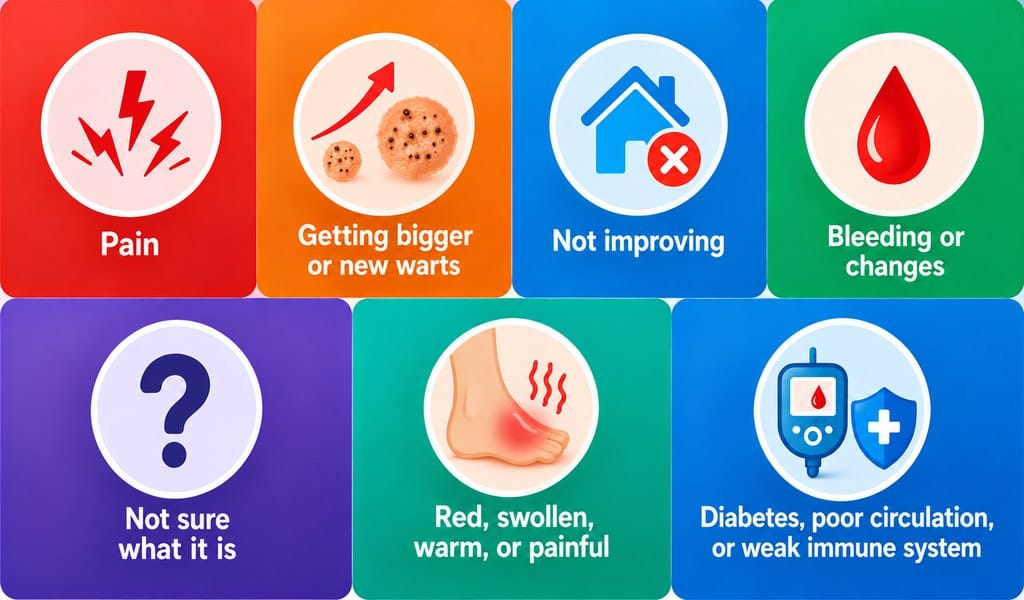
A small plantar wart that is not painful and does not change may not need immediate treatment. However, pain, rapid growth, bleeding, changes around the wart, or numbness in your foot may mean you should see a podiatrist.
Contact a podiatrist if you notice any of these warning signs:
- The wart hurts when you walk or stand.
- It keeps getting bigger or new warts appear.
- It does not improve with home treatment.
- It bleeds or changes in size, shape, or color.
- You are not sure if the bump is a plantar wart.
- The skin around it becomes red, swollen, warm, or painful.
- You have diabetes, poor circulation, or a weakened immune system.
If you need plantar wart care, Foot + Ankle Specialty Centers provides podiatry care with Dr. Sarraf and has over 1,000 reviews. You can make an appointment at one of their locations in Gilbert, Scottsdale, Chandler, Mesa, or Phoenix, Arizona.
Let’s Recap
Plantar warts can spread, but the virus that causes them is not highly contagious. Keep your feet clean and dry, cover the wart, and do not share shoes or towels. Avoid touching or picking the wart to help prevent spread. See a foot doctor if the wart hurts, changes, or does not go away.
FAQs
Yes. You can spread them by touching a wart or something that touched a wart.
Yes. They can still spread until the skin fully heals.
Yes, for a short time. Keep the area covered and clean while it heals.
Yes. The virus can live in warm, moist places like hot tubs.
Yes. You can spread or catch the virus in pools or showers.
The virus can spread when you walk barefoot or share towels, shoes, or socks.
Plantar warts can spread to other body areas, but spreading to the face is uncommon.
Plantar warts are contagious and can spread through direct contact or contaminated surfaces, especially in warm, damp areas.
Yes, they can. If you touch your foot wart and then touch your hand—especially if you have a cut or hangnail—the virus can spread to your hands.
- 1

Payam Sarraf
Payam Sarraf, DPM, is a podiatry specialist and surgeon at Foot + Ankle Specialty Centers, with offices in Gilbert, Scottsdale, Chandler, and Phoenix, Arizona. Dr. Sarraf’s areas of expertise include ankle trauma, Achilles tendon ruptures, podopediatrics, ankle arthroscopy and reconstruction and biomechanics.
Related posts
- Payam Sarraf
- September 3, 2026
- No Comments
Toe curling happens when your toes bend downward and inward toward the bottom of your foot. Common causes include muscle spasms, nerve problems, dystonia, toe deformities, […]
- Payam Sarraf
- August 29, 2026
- No Comments
Cracked heels develop when dry, thick skin splits under pressure from standing or walking. To help them heal, soak your feet, exfoliate the dry skin, moisturize […]

- Payam Sarraf
- August 29, 2026
- No Comments
High heels can cause a forward weight shift, which puts extra pressure on your toes and the front of your feet. A narrow toe box may […]